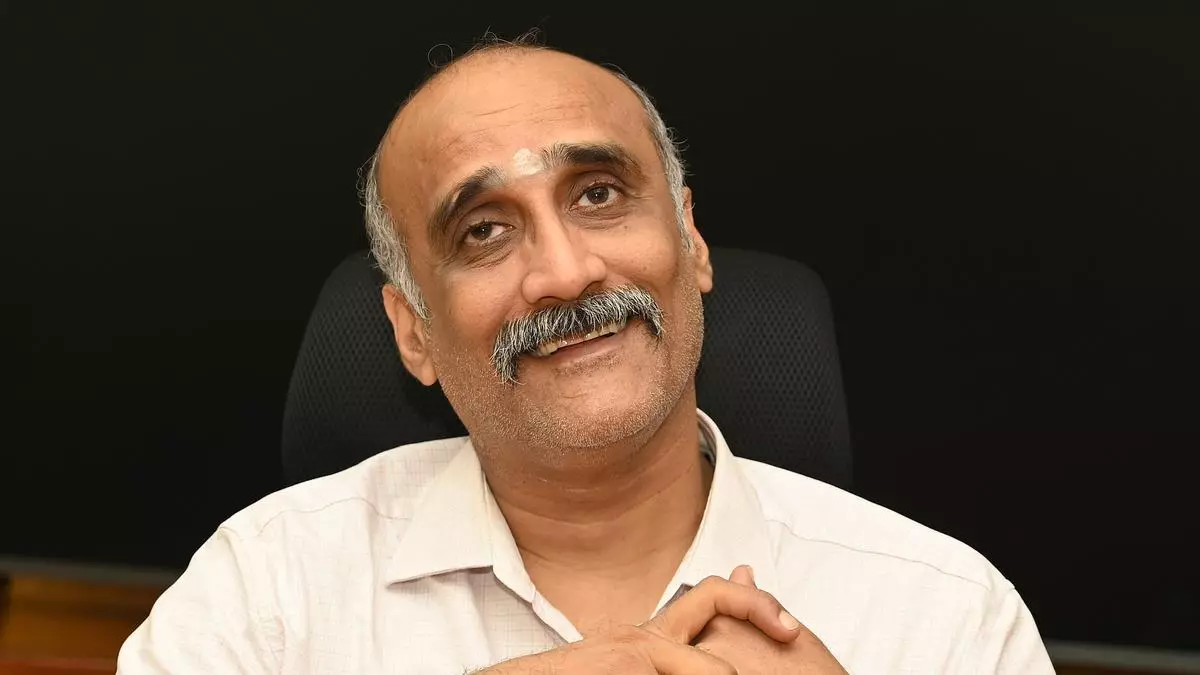
For Samsung, India is the second-largest R&D centre globally after Korea: Mohan Rao Goli, MD, Samsung R&D Institute

Samsung, the South Korea-headquartered conglomerate with diverse business interests, has had a long association with India. One of the key components of Samsung is its electronics division, which is one of the world’s largest in the IT, Consumer Electronics and semiconductor space. Mohan Rao Goli who is the MD of Samsung R&D Institute in India explained how the company views India not just as a key market but also as a important talent base for their global operations. Edited Excerpts:
Give us some perspective on how the India operations started, the kind of work being done here, and how significant India is to Samsung globally?
In 2004, Samsung became a private limited company [in India]. That may be why that year is often referenced, though we’ve had nearly three decades of presence in Bengaluru, having been here since 1996. I’ve been with the company for over 28 years. My focus has always been on wireless communications, starting with 2G and later leading Samsung’s global 5G initiatives. After the pandemic, I became CTO of Samsung R&D Institute Bengaluru, and around six months ago, I took over as head of the organisation (SRI). My expertise is in communication software, and my career has grown alongside the organisation’s expansion. There are six pillars to the growth of Samsung both globally and in India.
The first is wireless communications. The second is computer vision, especially in smartphone camera technologies. The third is system software, where we develop AI models and algorithms that are optimised for power, performance, and accuracy on compact devices. The fourth is the Internet of Things (IoT). After Samsung’s acquisition of SmartThings, IoT has become one of our major focus areas. The fifth is artificial intelligence (AI), particularly generative AI, which we integrate across our technology pillars to create meaningful user scenarios. And the sixth is services, such as Samsung Wallet and Samsung Finance+, which bring added value to consumers. Together, these six pillars define SRI Bengaluru’s contribution to Samsung Electronics globally.
On the services side, do you work with India’s tech ecosystem, or do you prefer to keep everything in-house?
We primarily build services in-house to retain control over IP. However, in some cases, we collaborate. For example, for our lending platform Samsung Finance+, we partner with leading financial institutions such as DMI to make Samsung devices more affordable for Indian consumers.
I meant more in terms of technology services — do you partner with Indian IT players?
The majority of our work happens in-house. However, if we see promising innovations in India, we connect with our Suwon (S Korea) R&D centers. If there’s alignment, collaboration is possible.
AI is the current buzzword. Could you share some concrete examples of AI innovations developed here?
With the Galaxy S24, we introduced Galaxy AI, which brings several AI-powered features to consumers. One key feature is Call Assist, which includes live translation. For example, if one person speaks in French and another in Hindi, the system translates in real time so both can have a seamless conversation in their own language.
How accurate and natural does this sound? Hasn’t that feature been around for some time?
It’s very natural and real-time with minimal latency. In fact, live translation is one of the most widely used Galaxy AI features, which speaks to its accuracy. We collect data on performance and keep refining it while also adding more languages. What’s different now is the accuracy. Earlier versions existed, but people didn’t use them much because the results weren’t reliable. With AI advancements, the accuracy of summaries and smart replies have improved dramatically. Another notable feature is Audio Eraser. For instance, if you record a video at a concert or a noisy event, background sounds can overwhelm the conversation. With Audio Eraser, you can suppress or adjust the noise level, making the dialogue clear.
This capability is available on Galaxy devices. We also developed Photo Assist. This includes several AI-powered tools like expanding photos by filling in missing portions of the frame, removing unwanted objects or people from images, optimising photos for wallpapers by adjusting layouts around widgets, and creating AI-generated portraits in different artistic styles such as comic or 3D. These features allow users to quickly edit, customise and enhance their photos.
How does Samsung’s strategy compare to other players who control both hardware and software as your devices run on Google’s Android?
We work closely with Google, using Android as the base platform for our devices. On top of that, we bring our own layer of innovation through One UI, which defines the interface between consumers and their Galaxy devices. Now, with Galaxy AI, we are adding another dimension of user experience. We believe AI will evolve into a new user interface for consumers. Our approach is hybrid: models that require fast, secure responses run on-device, while more complex models run on the cloud. This balance ensures accuracy, performance and privacy. Our goal is to democratise Galaxy AI. While the specific features vary depending on hardware capabilities, we are committed to making them accessible across different segments.
IoT is one of the hottest areas today. What’s happening on that front in terms of operations globally and in India?
Our SmartThings platform is integrated across consumer and Galaxy devices. Let me share a recent example. We launched a feature called ‘customised cooling’ within SmartThings. In India’s hot summers, many people wake up at night switching between ACs and fans to maintain comfort, which disturbs sleep. With SmartThings, Samsung ACs can connect with smart fans to automatically regulate the temperature throughout the night, ensuring uninterrupted and comfortable sleep. In a washing machine, for instance, it can sense the type of fabric you put in. In India, people are sensitive about delicate fabrics like sarees. With AI, you don’t need to set a cycle — it automatically adjusts.
Another example is stain wash. Since Indian diets involve more oily food, AI knows to heat the water and adjust the wash cycle accordingly. It minimises manual effort and gives peace of mind. The larger goal of AI is to make life easier. It’s not just a marketing label like Galaxy AI. It improves productivity, enables better communication — like real-time translations between Hindi and French — and enhances creativity.
While all our products are global, but in India, we account for local consumer needs and environment. That’s why we bring India-specific innovations, such as washing machine cycles, customised cooling for ACs, Galaxy AI language support, and voice focus to suppress background noise during calls. These features are incorporated into devices sold in India.
Of the 28 R&D centers globally, is India just one of them, including your presence in Bengaluru and Noida. Could you clarify whether the focus is mostly domestic or international?
India is the second largest R&D center (outside of Korea), so it naturally gets high visibility. India SRI contributions in collaboration with other R&D hubs are significant, especially in Galaxy AI and our six core technology pillars. We operate as one team. Bengaluru, Noida, Suwon, Poland — all collaborate on goals and features. Responsibilities are shared to launch features collectively. We are a part of the global team.
In Samsung’s India R&D facilities alone there are more than 7,000 people. India for us is more than a market, it is a base for leveraging the amazing talent available here for our global operations.