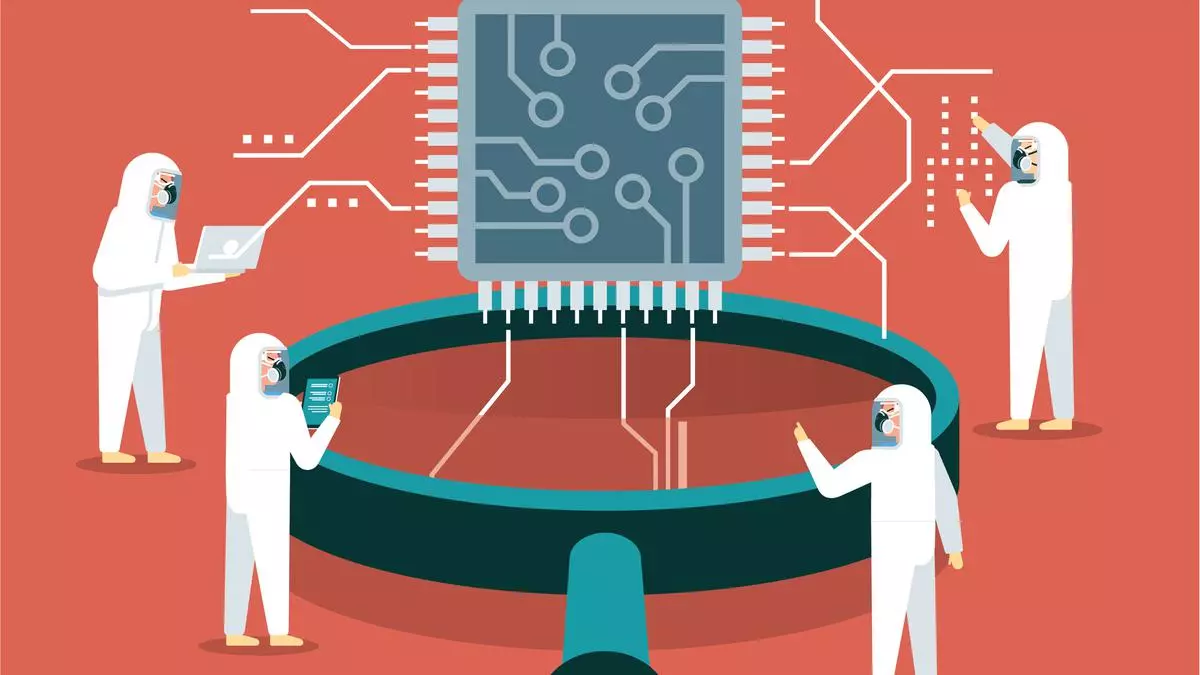

AI (Artificial Intelligence) concept. Communication network. istock photo for BL
| Photo Credit:
metamorworks
AI is transforming how companies hire – from sifting through thousands of resumes in seconds to expanding access to wider talent pools and even influencing termination decisions. Yet experts caution that without human oversight, the same algorithms meant to remove bias can end up amplifying it, especially when trained on skewed historical data.
In June, a class action lawsuit was filed against hiring software provider Workday, alleging its AI-powered job applicant screening system was “ageist” against candidates above 40. Last year, an employment discrimination complaint was lodged by Derek Mobley, who claimed that Workday’s algorithm-driven system unfairly screened applicants based on race, age, and disability.
Today, AI is increasingly being used to make the hiring process more efficient, addressing challenges like screening a large volume of applications to identify the right fit.
According to Upasana Raina, HR Director, GI Group Holding, by streamlining the initial screening stage, AI can improve both speed and efficiency, freeing recruiters from repetitive, time-consuming tasks and enabling them to focus on the most promising candidates. It can also expand access to a wider talent pool while helping reduce potential biases in the selection process.
“While AI is now widely used in hiring, many organisations have also begun applying it to the process of firing or letting go of employees, whether due to performance issues, lack of adequate projects, or disciplinary concerns. AI systems can track performance data and even issue automated warnings when problems are detected,” she observed.
However, while AI tools themselves don’t discriminate, the human bias baked into the data and filters creates the problem. Vishal Sharma, Co-Founder & CTO, CoHyre.ai, an agentic AI recruitment intelligence platform, highlighted that a hiring manager’s preferences can be fed into the system, which then customises the results.
“Responsible companies try to mitigate this by auditing their tools and making sure they are not inadvertently filtering out candidates based on age or other factors, and instead are only evaluating based on pure experience,” he said.
If historical hiring data reflects biases related to gender, race, or other factors, and this data is used to benchmark high-performing employees, the AI may adopt similar patterns. As a result, the technology could reinforce the very disparities it aims to address.
To address biases, Dr. Adnan Masood, PhD. Chief AI Architect of UST said companies can refer to New York City’s Local Law 144 AI in Hiring, which requires mandatory annual third-party audits before deployment. Another method could be to implement Blendoor’s design fairness approach by removing names, photos, and dates from algorithmic processing. Data indicates that companies following these guidelines achieve a reduction in protected class disparities.
Organisations using AI can resort to data remediation. Techniques like oversampling can address inaccuracies caused by incomplete past data. Alongside, mandating blending big data analysis with small data can prevent correlation-causation errors.
“For instance, most tech clients’ engineering datasets are male-dominated; therefore, synthetic data and vector space corrections before allowing any AI deployment are mandatory. Without these interventions, you’re essentially automating discrimination at scale,” Masood shared.
Raina pointed out that human potential is best assessed by people and not technology. AI should act as a supportive tool in the hiring process, rather than serving as the sole decision maker.
“Recruitment is, at its core, about people, making the balance between technology and human judgment essential. Beyond qualifications, hiring involves evaluating a candidate’s scalability and future potential, attributes that require human insight. Subtle cues like body language, expressions, and interpersonal dynamics can only be understood through direct human interaction. Above all, candidates themselves value and expect genuine engagement with people, not just machines,” she explained.
Technology like AI can be used to objectively analyse data. However, factors like workplace environment, organisational culture, managerial style, and difficulty level of tasks require human evaluation and empathy. Even during termination, assessing the full context and executing the decision with sensitivity should involve human beings.
Published on August 11, 2025